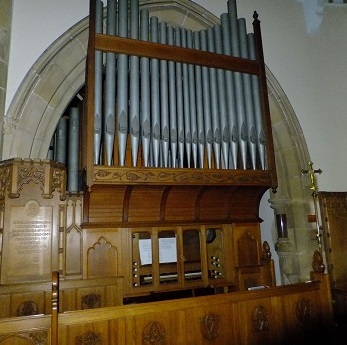
The organ was built in 1903/04 by John Robertson Miller of Dundee (1857 -1941) The cost was £266/0/11, with an additional £5 for “special pipes”. These may be the dummy pipes at the two front corners of the case. They each have two mouths. One facing the front and the other to the side. Miller did not make his own organ pipes. They were all bought-in from an outside source, possibly from J W Walker one of the finest and busiest Victorian organ builders. Miller had, around 1883, moved to London to train with Walker. There he acquired advanced skills in wood, metal and leather work and the voicing and tuning of every variety of organ pipe.
(Imagine a possible scenario prior to 1903 when Miller submits his quote for the splendid new organ he is to build in St Mary’s, Newport. The church is shocked at the cost and ask him to go ‘sharpen his pencil’ and try again. He returns with a simplified and less expensive scheme. The Swell Viola and Pedal Cello are now ‘prepared for’ only. There are no large bass pipes for the Dulciana, No ‘luxuries’ such as a balanced Swell Pedal or angled stop jambs. There still is, however, a very finely carved, splendid organ case to admire.)
Wind was raised, as was common at this time, by a water engine. This was installed in the boiler room under the organ and vestry. The high pressure of the local water supply was used to move a piston forward and back in a cylinder. (e.g. as steam in a railway locomotive) This movement worked two or more feeders (like large fire bellows) forcing wind into a large wind reservoir inside the organ case. The rise of the reservoir top was, and still is, controlled by springs, weights and an entry valve to maintain a constant wind supply at a steady pressure.
In November 1904 an ad was placed in the local newspaper for an organist and choirmaster at an annual salary of £15. To choose between the applicants an organ playing competition was held in the parish church on their new Willis organ and Miss Lowson was unanimously elected.
In November 1920, after much procrastination, her salary was increased to £30 a year! The following month Miller overhauled and cleaned the organ at a cost of £19/15/-
Miss Lowson died in office in 1933.
A newspaper cutting submitted in the 1920s by a former choirboy shows that fun could be had with the water engine. “….much to the annoyance of the organist Miss Lowson, when she was practising, one of the boys would lower and raise the pressure of the water alternately, resulting in a most unusual sound….!”
The next organist was Ernest W Brady, aged just 15. He held the post till the outbreak of war. His starting salary was £20pa but was increased to £30pa in 1934. During the war, Ernest was ordained for the ministry and eventually became Dean of Edinburgh Diocese.
The need for further overhaul was mentioned in 1937, but nothing was done for 10 years, presumably because of the war. Mrs MacIntyre, the Rector’s wife, acted as organist and choirmaster throughout the war.
Plans for “the completion of the organ” by the addition of the two ‘prepared for’ stops (Swell Viola 8 and Pedal Cello 8), as well as the long overdue overhaul, were made in 1947. The work was carried out by Fredrick Rothwell & Sons of Harrow in late 1947/early 1948. The cost was £293+ purchase tax.
By March 1949 the “water engine” had become unreliable so the advice of Rothwells was accepted and it was replaced with an electric blower. ‘Unreliable’ could refer to an erratic water pressure problem caused by extra demand from all the new buildings around Newport.
In 1966 the organ again required refurbishment, this time the work was done by James Mackenzie of Glasgow at a cost of £335. This would fit with a recommended health check at roughly twenty or thirty year intervals.
By 1997, it became obvious that the organ required major refurbishment, this time costing thousands. A vigorous programme of fund raising followed, and by 1999 almost all the money required had been raised. The work was entrusted to A F Edmonstone of Forteviot, and it took many weeks to complete. A quote from the time states “There were organ pipes lying everywhere – it looked scary!” The worn old Sw & Gt tracker action was rebuilt using modern lighter materials. The collapsing Sw Oboe pipes were replaced with a Sesquialtera. and the much altered Harmonic Flute 4 with a new Principal. The 30 pedal pipes of the Rothwell Cello were removed and discarded. They had been mounted in front of the Great pipes. It is a pity they could not be accommodated elsewhere as they were a standard inclusion in the specification of many of Miller’s organs. Their purpose was to give greater clarity to the pedal part. The cut off stumps of their pneumatic action can still be seen protruding from the pedal touch box. The large double-rise reservoir was re-leathered. (Was it always double rise? Something we will never know.)
Two successful organ recitals were held to celebrate the completion of all the work.
The organ is now maintained regularly by Paul Miller (no relation) and is kept in tip top condition.
GREAT
Diapason 8 (orig Miller)
Flauto Traverso 8 (orig Miller)
Dulciana 8 (orig Miller) the bottom octave shares the flute pipes
Principal 4 (Edmonstone) (replaced orig Miller Harmonic Flute 4)
SWELL
Lieblich Gedeckt 8 (orig Miller)
Viola 8 (Rothwell) (Miller prepared for)
Voix Celeste 8 (TC) (orig Miller)
Gemshorn 4 (orig Miller)
Sesquialtera 2ranks (Edmonstone) (replaced orig Miller Oboe)
PEDAL
Bourdon 16 (orig Miller)
Blank Stop Knob (was Rothwell Cello 8) (Miller prepared for)
Swell to Great
Swell to Pedal
Great to Pedal
Two Combination pedals to Great
Two Combination pedals to Swell
Trigger Swell Pedal (4 settings)
Mechanical action for manuals and couplers
Charge pneumatic action to Bourdon and some Sw and Gt bass pipes.
In his day John Robertson Miller built, rebuilt and looked after most of the organs in the wider Dundee area. Sadly, most have been scrapped as church buildings closed or new styles of music making took over.
The St Mary’s organ is fast becoming a rare survivor. Fortunately the craftsmanship of John Miller can still be appreciated here. Every Sunday the organ’s beautiful clear tones can be heard playing a major part in worship.
 St Mary's Scottish Episcopal Church